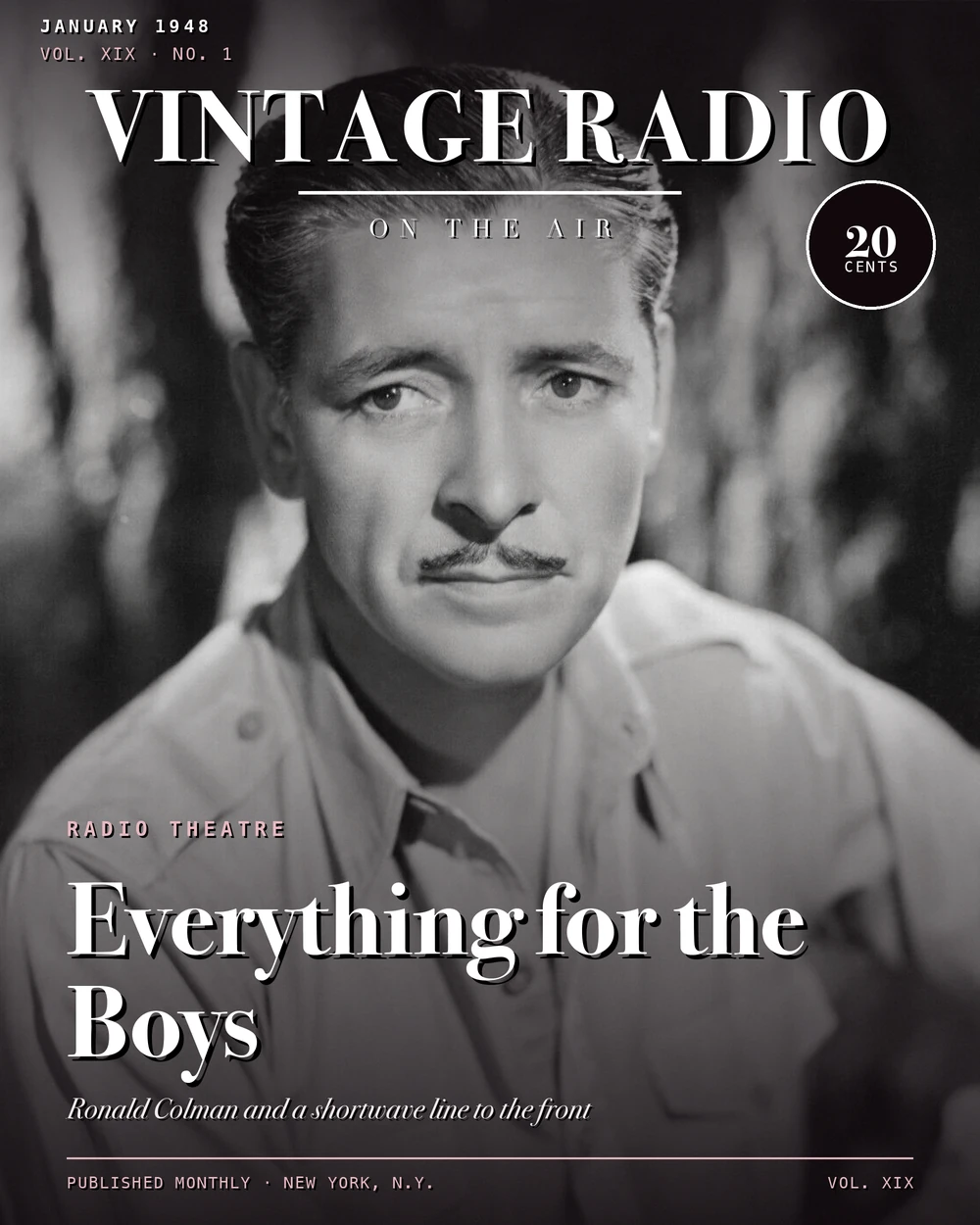
Everything For the Boys
A Show Unlike Anything Else on the Air
Everything For the Boys launched on NBC on January 18, 1944, with a concept that hadn't quite been tried before: a top-flight dramatic anthology starring one of Hollywood's most recognizable voices, paired with a shortwave hookup that pulled actual servicemen in distant war zones into the broadcast in real time. The sponsor was the Electric Autolite Company, whose owner George Armstrong had been behind the idea from the start. The premise was simple enough — run a polished radio play, then connect soldiers in places like Australia, New Guinea, and Algiers with their wives and families back home, live on the air, four to six minutes at a stretch.
The premiere set the tone immediately. Ronald Colman headlined an adaptation of Robert E. Sherwood's The Petrified Forest, with Academy Award winner Ginger Rogers as his guest. After the play, the shortwave segment brought in two young bomber pilots stationed at an air base in England, reportedly about to fly their fiftieth mission. The NBC studios in Hollywood were suddenly sharing a frequency with the front. Producer and writer Arch Oboler kept an alternate script in hand every week in case the shortwave connection failed — which tells you something about how technically unpredictable this part of the show actually was.
Ronald Colman and Arch Oboler: The Collaboration That Worked Anyway
The pairing of Ronald Colman with Arch Oboler was the creative engine of the show's first phase, which ran 21 weeks through June 1944. Colman, born in Richmond, Surrey, in 1891, had built a film career partly on the strength of a voice that translated effortlessly to radio. But despite his long Hollywood presence, Everything For the Boys was his first regular dramatic vehicle on radio — his earlier 1939 program The Circle having been, in radio historian Carroll Carroll's phrase, "radio's most expensive failure."
Oboler, a Chicago-born writer who had sold his first radio script to NBC in 1933, arrived with an already established reputation for original, sometimes eccentric work. Time magazine had described him as a "horn-rimmed half-pint scrivener," and his working habits did nothing to soften the image. According to Juliet Benita Colman's biography of her father, Oboler wrote and directed in dirty dungarees, no socks, thong sandals, and a hat with a grease-stained band. Colman's idea of casual dress ran to immaculate sweaters and well-pressed tweeds. The two men, by Oboler's own later account to writer Sam Frank, "hated each other's guts."
The tension surfaced regularly in rehearsal. Associate producer Barbara Merlin described an incident where Oboler told his assistant director he wished someone would tell Colman how not to read a line; Colman shot back that he wished Oboler would get his pants pressed. A Radio Life reporter who attended a March rehearsal overheard Oboler snap, "What's the matter, Ronnie, is it too early in the morning to turn on your charm?" — and apparently mistook it for good-natured ribbing. Insiders suspected Oboler's eccentricity was partly performance; he had a habit of producing his script at the last moment, to give the impression he had just dashed it off.
The creative disagreement ran deeper than wardrobe. Oboler preferred to write original plays; Colman preferred adaptations of established classics and films. Oboler thought it ridiculous to compress Of Human Bondage into twenty minutes. Colman had more clout, and his preference generally won. The result was a season of notable guests working through well-known material: Greer Garson in Berkeley Square, Ingrid Bergman in Death Takes a Holiday, Loretta Young in Blithe Spirit. In one memorable surviving moment, Bergman, at a soldier's request during the shortwave segment, sang "As Time Goes By" from Casablanca; in another broadcast, Colman recited the poem "High Flight." Oboler did manage a few originals, including a reworked version of his earlier anti-war play "The Women Stayed at Home," recast as a WWII morale piece set in Norway under German occupation, with Colman playing a British flyer and Mercedes McCambridge in a supporting role.
The Show Pivots
The Colman-Oboler phase ended in June 1944. The show was preempted on D-Day, returned for one final dramatic-anthology broadcast, and then on June 27 was reorganized entirely as a musical variety program. Dick Haymes and Helen Forrest stepped in as the new headliners, with Gordon Jenkins continuing as orchestra leader.
Haymes and Forrest already knew each other's work. They had been together on the CBS program Here's to Romance — Haymes had taken over that show from vocalist Buddy Clark in July 1943 — and left when the opportunity came to join Everything For the Boys. Their on-air partnership clicked. All About Jazz later called their recorded collaboration "one of the best in the history of popular music." Their hit duets from this period included "Long Ago (And Far Away)," "It Had to Be You," "Together," and "I'll Buy That Dream." Jenkins, who had been Haymes's arranger for roughly four years by this point, provided the musical backbone. Born in Webster Groves, Missouri, in 1910, he would eventually be inducted into the Songwriters Hall of Fame in 1982; his best-known compositions included "Goodbye," "P.S. I Love You," and "San Fernando Valley."
The musical variety version carried the Everything For the Boys title until the format had fully shifted its identity to its male star, at which point it became The Dick Haymes Show. That program ran on NBC through October 1945, moved to CBS until July 1948, and was also carried by the Canadian Broadcasting Corporation. The Autolite sponsorship persisted; for a time the show was also known as Your Auto-Lite Party. In 1946, Helen Forrest left, replaced by Martha Tilton and Lina Romay. Comedian Cliff Arquette joined in 1947 in the comic role of Mrs. Wilson, a flower-stand owner perpetually confused about the time of day.
The People Behind the Scenes
The supporting cast of writers and producers on Everything For the Boys was, by any measure, a remarkable group. Barbara Smitten — later Barbara Merlin — had trained as a radio writer at station KFRC in San Francisco, then worked at KHJ in Los Angeles and at the advertising agency Ruthrauff and Ryan, which produced Amos 'n' Andy and Mayor of the Town, before coming aboard as script supervisor and associate producer. It was on this show that she met writer Milton Merlin. They married in 1945 and spent the next two decades collaborating on radio and television. Milton Merlin had come from film — Paramount Pictures from 1933 to 1936, then an assistant producer role at MGM before shifting to radio around 1940. He later served as national president of the Radio Writers Guild in 1952, and was eventually blacklisted during the anti-Communist campaigns that followed, his name blocked from appearing on scripts for the televised Halls of Ivy. Their papers, held at UC Santa Barbara's American Radio Archives, include scripts, correspondence, and production materials from the show.
Jerome Lawrence was another writer on the program. He had been a senior staff writer at CBS Radio from 1939 to 1941 before joining. Lawrence and his collaborator Robert E. Lee had co-founded Armed Forces Radio; they are best known for the plays Inherit the Wind and Auntie Mame, and Lawrence was inducted into the National Theater Hall of Fame in 1990. Frank Martin served as announcer throughout the run. Oboler's archive, including materials related to Everything For the Boys, is held at the American Heritage Center at the University of Wyoming.
What Came After
Ronald Colman's post-show career in radio found him in more comfortable surroundings. Beginning December 9, 1945, he and his wife Benita Hume became a recurring presence on The Jack Benny Program, playing the Benny family's next-door neighbors in a running gag that continued until 1951. He went on to host the syndicated series Favorite Story from 1947 to 1949, then starred as Dr. William Todhunter Hall in The Halls of Ivy on NBC Radio from 1950 to 1952. In 1947 he won the Academy Award for Best Actor for A Double Life, along with the Golden Globe the same year. He died in Santa Barbara in 1958.
Oboler kept working in ways that suited his restless instincts. His 1951 post-nuclear war film Five preceded his writing, producing, and directing of Bwana Devil in 1952, the film widely credited with starting the short-lived 3D movie craze of that era. His Malibu home was designed by Frank Lloyd Wright. He died in March 1987.
Everything For the Boys ran in its original dramatic-anthology form for 21 weeks, then shifted format and continued under a new identity for more than a year after that. Contemporary commentators characterized the Colman-Oboler phase as a semi-propaganda effort aimed at American troops overseas — a fair description, given Oboler's stated commitment to supporting the war effort in the years after Pearl Harbor. But the specific texture of the show — a sharp-tongued writer and a polished film star who couldn't stand each other, turning out twenty-nine minutes of quality drama each week and then patching a live call through to the South Pacific — was something that could only have existed when it did, under the conditions that produced it.